About the author

Vinko Borčić
Project Manager and Product Owner
Picture this: You’ve just spent six months and a huge chunk of your budget building what you thought was the perfect product. Your team worked tirelessly, the code is clean, the design is polished, and you’re ready to launch. But then reality hits – customers aren’t buying. The market response is lukewarm at best, leaving you wondering what went wrong.
This scenario plays out more often than you’d think. Studies show that 42% of startups fail because there’s no market need for their product. That’s nearly half of all startup failures, and it’s a problem that could be largely avoided with proper product discovery.
What is product discovery?
Product discovery is all about figuring out what to build before you build it. It’s about truly understanding your customers, identifying real problems worth solving, and validating your ideas before investing significant resources in development.
Think of it as your insurance policy against building the wrong thing. Instead of assuming you know what customers want, product discovery helps you learn what they need through research, experimentation, and continuous feedback.
The process typically involves interacting with customers, analyzing market trends, testing assumptions, and refining ideas based on what you learn. It’s not a one-time activity, but an ongoing practice that should occur alongside your product development efforts.
Why product discovery matters more than ever
The cost of getting it wrong has skyrocketed
Building the wrong product isn’t just disappointing – it’s expensive. When you factor in development costs, marketing spend, lost opportunity costs, and the time your team could have spent on something valuable, the price of failure becomes staggering.
Many companies have spent millions developing products they believed would revolutionize their industries, only to discover that customers didn’t have a real need for what they built. The failure often comes from not understanding what customers wanted versus what seemed technologically impressive.
The market has fundamentally changed
Today’s customers have more choices than ever before. They’re sophisticated, their needs are evolving rapidly, and they won’t settle for products that don’t solve real problems. The days of “build it and they will come” are long gone.
Social media and online reviews mean that bad products are quickly called out, while good products can spread like wildfire. This creates both opportunity and risk. Get it right, and you can grow faster than ever before. Get it wrong, and the market will let you know immediately.
Competition is fierce across every industry
In most industries, multiple solutions are competing for the same customer attention. The products that win aren’t necessarily the ones with the most features or the slickest design. They’re the ones that solve the most critical problems in the most effective way for their target customers.
The transformative value that product discovery brings
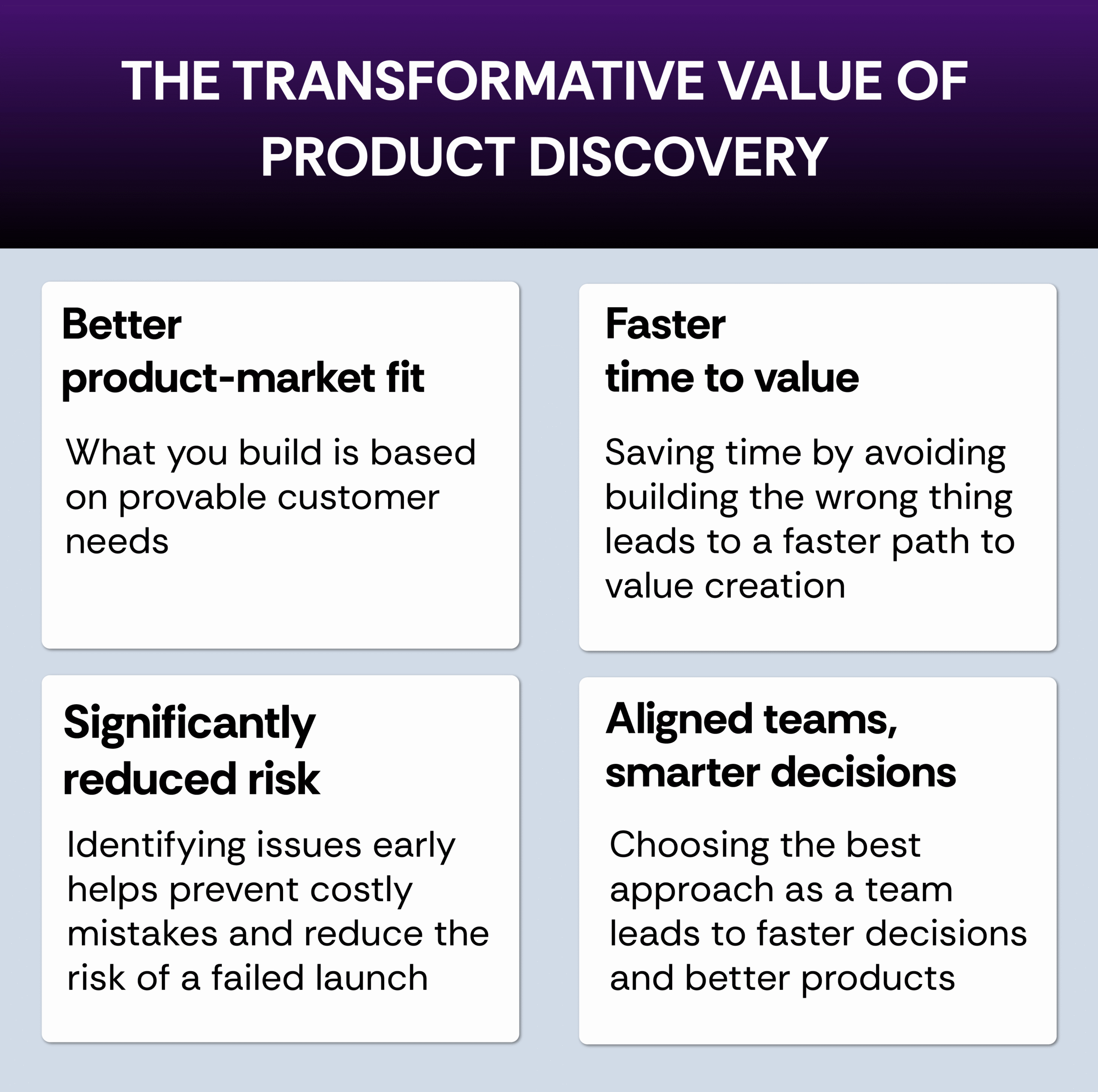
Better product-market fit
Product-market fit is that magical moment when your product resonates so strongly with your target market that customers can’t imagine living without it. It’s when growth becomes easier because customers are actively seeking you out and recommending you to others.
Product discovery dramatically increases your chances of achieving product-market fit because it’s built on understanding real customer needs. Instead of guessing what might work, you’re building based on evidence of what customers struggle with and value.
Faster time to value
This might seem counterintuitive. After all, discovery takes time upfront. However, when you factor in the time saved by not building the wrong things, not having to completely pivot after launch, and avoiding the need to rebuild features that don’t work, discovery accelerates your path to creating value.
Teams that practice good product discovery tend to build fewer features overall, but those features have much higher adoption rates and customer satisfaction scores.
Significantly reduced risk
Every product decision involves risk. Will customers want this feature? Will they pay for it? Will it solve their problem better than existing alternatives? Product discovery doesn’t eliminate risk, but it significantly reduces it by replacing assumptions with evidence.
When you test ideas early and often, you catch problems before they become expensive. You can pivot based on learning rather than being forced to change course after a failed launch.
Better team alignment and decision-making
One of the hidden benefits of product discovery is how it aligns your team around a shared understanding of customer needs. When everyone has participated in customer research and heard firsthand what customers struggle with, debates shift from opinions to evidence.
Instead of arguing about which feature to build next, teams can discuss which approach best serves the customer problems they’ve identified. This leads to faster decision-making and more cohesive products.
Busting common myths about product discovery
“We don’t have time for discovery.”
This is the most common objection, and it’s understandable. When you’re under pressure to deliver, spending time on research can feel like a luxury you can’t afford. But this thinking is backwards.
The teams that feel like they don’t have time for discovery are usually the ones who need it most. They’re likely stuck in a cycle of building features that go unused, fixing problems they could have avoided, and constantly putting out fires instead of making strategic progress.
“The stage we’re in is too early for formal discovery.”
Product discovery isn’t about asking customers what to build. It’s about understanding their problems, motivations, and the contexts in which they operate. Customers might not know they want a car, but they can tell you about the challenges of getting around town and the limitations of their current transportation options.
“We already know our market inside and out.”
Even if you’ve been in an industry for years, customer needs evolve, new segments emerge, and the competitive landscape shifts. What worked yesterday might not work tomorrow. Companies that assume they know their market often miss critical changes in customer behaviour and preferences.
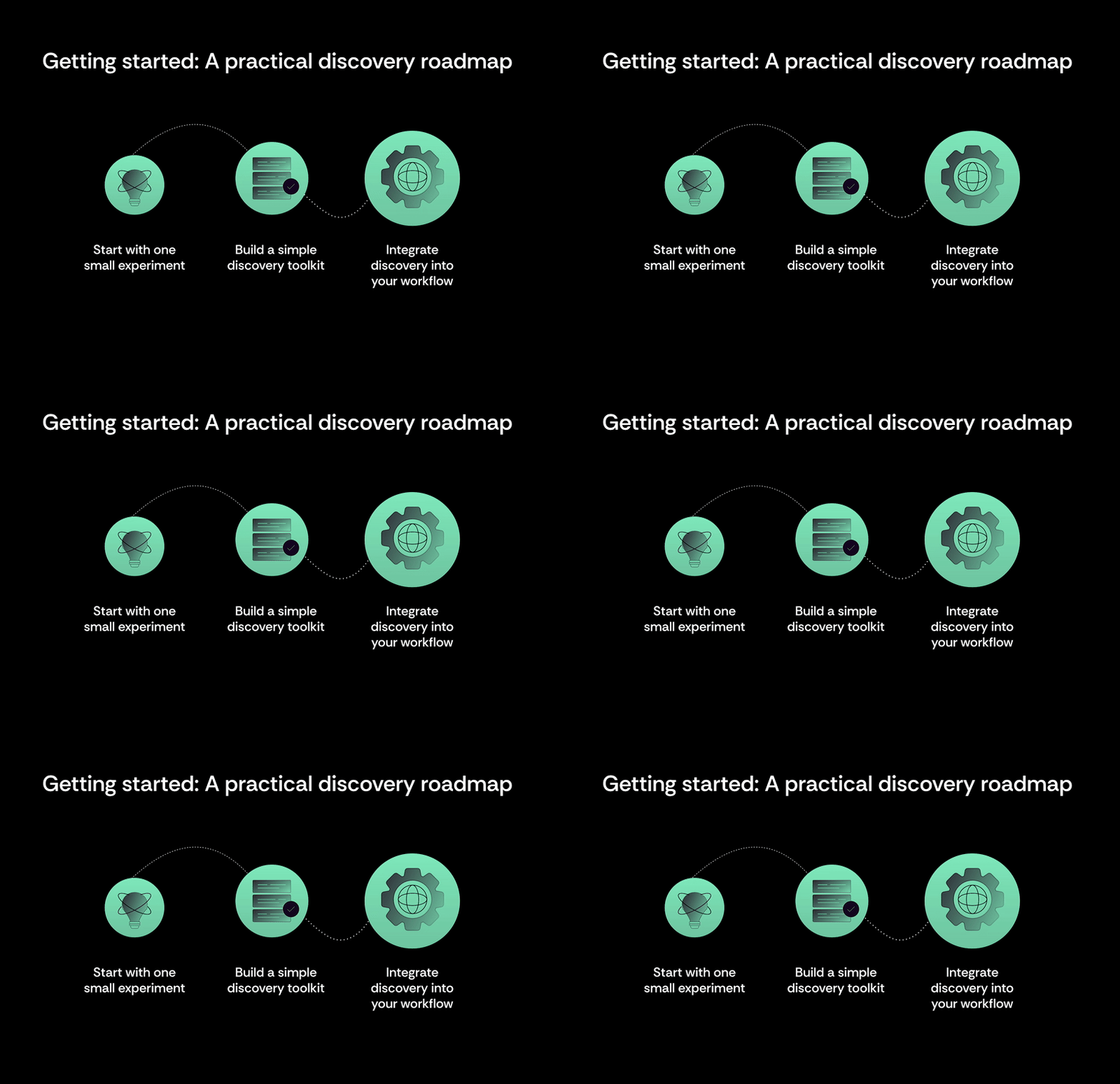
Getting started: A practical roadmap
Start with one small experiment
If your organisation is new to product discovery, don’t try to implement a comprehensive program overnight. Start with small experiments that demonstrate value.
Select one upcoming feature or product decision and spend a week talking to customers about it. Conduct 5-10 customer interviews to gather information about their current solutions, pain points, and desired outcomes.
Build a simple discovery toolkit
You don’t need expensive tools to start. Create a customer interview guide with open-ended questions that focus on problems rather than features. Establish a research repository to capture insights and track your key assumptions about customer needs. If you’re considering more advanced approaches, such as discovery workshops tailored to emerging technologies, you may want to learn how to know you need an AI discovery workshop.
Integrate discovery into your workflow
The most successful teams integrate discovery into their existing workflow by incorporating customer perspectives into sprint planning sessions, including user research findings in feature specifications, and scheduling regular customer feedback sessions.
The bottom line: Discovery is survival, not luxury
Product discovery isn’t just a nice-to-have – it’s essential for building products that customers want and use. In a world where customers have endless choices and short attention spans, understanding their real needs isn’t optional.
The companies that invest in discovery don’t just build better products; they build more successful businesses. They waste less time on features that don’t matter, achieve product-market fit faster, and create loyal customers who become advocates for their brand.
Yes, discovery takes time and effort upfront. But when you consider the cost of building the wrong thing, the investment pays for itself many times over. More importantly, it sets you up for sustainable growth based on real customer value rather than wishful thinking.
The question isn’t whether you can afford to do product discovery – it’s whether you can afford not to. In today’s competitive market, understanding your customers isn’t just an advantage; it’s a matter of survival.
Start small, stay curious, and remember that the best products emerge from a deep understanding of customers, not brilliant guesses. Your customers are waiting to tell you what they need – you have to ask the right questions and listen carefully to the answers.
So, no more guessing: our Product Discovery service will help you validate before you build. Get in touch with us to protect your investment.