
About the author

Vinko Borčić
Project Manager and Product Owner
The difference between market leaders and laggards often comes down to one critical capability: the ability to discover and build products that customers actually want to use. And while your product teams focus on the tactical execution of discovery processes, as a business leader, your role is to champion, fund, and scale these initiatives across your organization. According to recent industry analysis, 34% of startups fail due to a lack of product-market fit. This is a problem that proper product discovery directly addresses.
This isn’t just about avoiding failure; it’s about unlocking exponential growth. According to BCG‘s Most Innovative Companies report, the top 50 most innovative companies outperform the MSCI World Index on shareholder return by 3.3% per year. And this compounds over time.
The business case for digital product discovery
Strategic imperative in the digital age
Digital products have become the primary value drivers for businesses across every industry. Whether you’re a traditional enterprise undergoing digital transformation or a digital-native company, your ability to consistently discover and deliver valuable digital solutions directly impacts your bottom line and competitive position.
The financial impact of poor discovery is nothing to sneeze at. McKinsey reports that 17% of IT projects fail the business trying to execute them, while 42% of startups fail because they develop products that the market doesn’t need. Even more concerning, 50% of a product’s development cost can be wasted on features that add no value.
ROI of strategic discovery investment
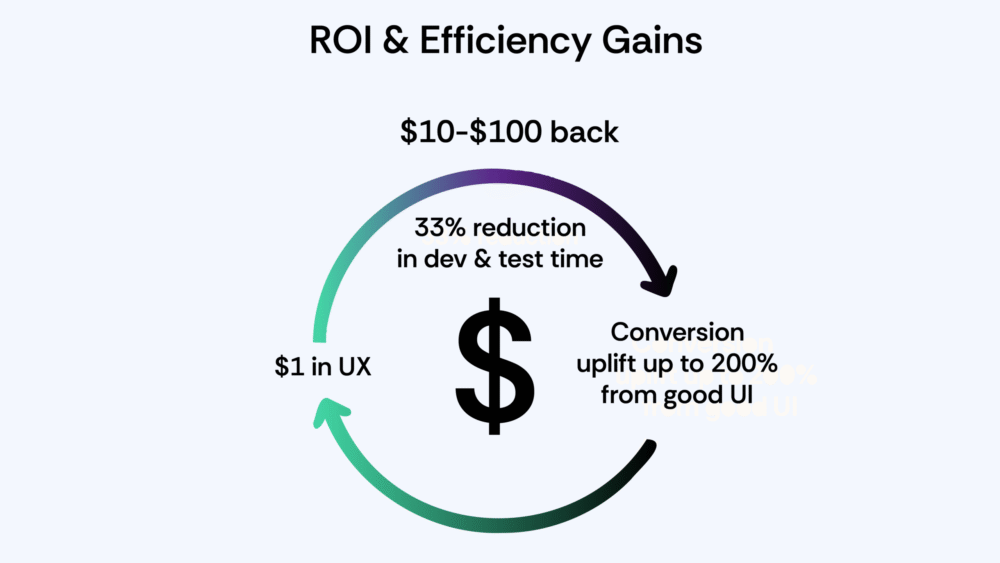
The return on discovery investment is compelling when viewed through a strategic lens. Every dollar invested in UX brings between $10-$100 in return. But the benefits extend far beyond immediate financial returns.
Organizations with mature discovery practices report a 33% reduction in development and testing time. These improvements compound over time, creating sustainable competitive advantages that are difficult for competitors to replicate.
The leadership challenge
Treating discovery as a checkbox exercise stands as one of the most common pitfalls we encounter in product discovery. And there’s independent data to support this. Specifically, according to CB Insights, 35% of startups fail because they launch products with no market need, making product/market misfit the most common single cause of failure.
Then there are stakeholder alignment challenges, when organizations struggle to align diverse stakeholders. Any product-led transformation should have an executive sponsor who has defined a clear “why” for transformation. This should first be defined at the executive level and communicated to the rest of the organization. When this alignment is missing, then discovery initiatives become isolated experiments instead of strategic transformations.
Leaders must also navigate the tension between short-term delivery pressures and long-term discovery investments. Change is never easy, but it gets progressively more difficult without a clear purpose everyone can rally behind.
Strategic implementation framework
Phase 1: Foundation setting and strategic alignment
The first phase focuses on establishing discovery as a strategic capability aligned with your broader business objectives. This begins with defining clear value drivers aligned to business strategy and ensuring that proposed changes contribute towards achieving the organization’s goals.
Key activities include conducting a discovery maturity assessment of your current capabilities, identifying the gap between current state and desired outcomes, and securing internal buy-in from key stakeholders, with clear communication of the transformation vision. You’ll also need to establish success metrics that matter to business leaders, moving beyond traditional product metrics to include business impact indicators.
During this phase, invest in bringing the right talent, nurturing it the right way, and creating the appropriate structure and processes. This includes identifying internal champions who can drive change from within existing teams and securing budget allocation that treats discovery as a strategic investment instead of as an operational expense.

Phase 2: Team empowerment and capability building
The second phase focuses on building discovery capabilities within your product teams while maintaining delivery commitments. This requires stakeholder relationship management, which should establish trust and credibility with your product teams.
Implement the core product trio structure consisting of product manager, UX designer, and software engineer roles. Take care to ensure that each role understands their individual responsibilities, as well as the collective accountability for discovery outcomes. Provide training and coaching to help teams transition from feature-focused to outcome-focused thinking.
Support continuous discovery alongside delivery by building agile processes and routines. This includes creating protected time for customer conversations, assumption testing, and solution validation. The goal is to make discovery a habit rather than an event.
Phase 3: Scaling and strategic integration
The final phase involves scaling discovery practices across multiple teams and integrating insights into strategic planning processes. This requires developing cross-product integration that increases customer value when products are used in combination and establishing portfolio performance metrics that track discovery effectiveness at scale.
Key success factors in this stage include:
- Creating knowledge-sharing systems that prevent teams from repeating discovery work;
- Establishing centers of excellence that can support scaling efforts, and;
- Integrating discovery insights into strategic planning cycles
Digital-specific considerations
Digital products require additional considerations around data privacy, technical feasibility, and platform integration. Leaders must ensure discovery practices account for technical constraints and opportunities. This includes using AI tools to identify patterns and trends in user data while maintaining human interpretation by UX researchers who are better at interpreting findings within cultural and social contexts.
Measuring product discovery success
Leading indicators for business leaders
Product teams track tactical metrics. But business leaders need indicators that predict business outcomes. Key leading indicators include:
- Learning speed – how quickly teams can test and validate assumptions
- Quality of assumption testing – evaluating the thoroughness of experimentation methods
- Customer conversation frequency – how often touchpoints with real users occur
Track metrics like time-to-insight, hypothesis validation rate, and the percentage of decisions supported by customer evidence.
Business impact metrics
The ultimate measures of discovery success are business outcomes. Focus on product-market fit indicators such as customer satisfaction, retention, organic growth. Also consider development waste reduction, specifically the percentage of features that drive meaningful user engagement. Lastly, also factor in the strategic alignment, i.e. how well discovery insights inform strategic decisions.
Additionally, to gauge success over previous versions, track conversion rate improvements. Studies show that well-designed user interfaces, for example, could boost website conversion rates by up to 200%.
Organizational health metrics
Discovery success also impacts organizational effectiveness. Monitor team alignment scores (how well teams understand priorities), decision-making speed (time from insight to action), and cross-functional collaboration effectiveness. These metrics predict long-term capability development and sustainable competitive advantage.
Overcoming implementation challenges
Managing stakeholder resistance
Stakeholder resistance often stems from concerns about delivery speed and resource allocation. Address this by demonstrating quick wins that showcase the value of discovery, establishing clear communication about how discovery supports rather than slows delivery, and providing transparent reporting on discovery ROI.
Another method is to involve stakeholders in discovery activities. In addition to offering a view into the process, it helps to establish shared language and understanding across departments. When stakeholders have an opportunity to observe customer conversations or participate in assumption mapping exercises, they develop firsthand appreciation for discovery’s strategic value.
Resource allocation and budget management
Balance discovery investment with delivery commitments by treating discovery as parallel rather than sequential activities. Research suggests allocating around 10-20% of your total project budget to the discovery phase, but this investment should be continuous rather than front-loaded.
Establish clear criteria for discovery investment decisions, focusing on high-impact opportunities that align with business strategy. Track total cost of ownership including implementation costs and ongoing operational costs to make informed resource allocation decisions.
Scaling without losing quality
Maintain discovery quality as teams grow by establishing standards and frameworks rather than rigid processes. Create centers of excellence that can support scaling efforts and implement knowledge management systems that capture and share discovery insights across teams.
Focus on teams where you have direct influence and deliver impactful results that can positively affect other areas. Success in one area often creates pull for discovery adoption in others, making scaling more sustainable.
Future of discovery-driven organizations
Emerging trends and opportunities
The future of discovery lies in leveraging AI tools to identify patterns and trends while maintaining human interpretation for cultural and social context. Organizations that successfully integrate AI capabilities into their discovery processes will gain significant competitive advantages in speed and scale.
AI product discovery is the magic bullet for many organizations that are looking to automate workflows and processes. Discovery-driven organizations will be better positioned to identify and capitalize on AI opportunities because they maintain continuous customer connection and assumption validation capabilities.
Competitive advantage sustainability
Organizations that embed discovery into their strategic toolkit create sustainable competitive advantages that compound over time. These capabilities become increasingly difficult for competitors to replicate because they require a complete cultural transformation, not just process adoption.
Call to action for leaders:
Begin treating discovery as a strategic capability that requires long-term investment and organizational commitment. The companies that make this transition successfully will dominate their markets in the next decade.
Conclusion
Product discovery isn’t just a tactical process for product teams – it’s a strategic capability that drives business performance and competitive differentiation. The best product teams don’t see discovery as a project that has a start and finish. Instead, this is viewed as a continuous discipline that informs everything they do moving forward.
As a business leader, your role is to champion discovery as a strategic investment, provide the organizational support necessary for teams to succeed, and integrate discovery insights into strategic planning processes. Organizations that make this transformation successfully will be the ones that thrive in an increasingly uncertain and competitive business environment.
The choice is clear: invest in discovery capabilities now, or risk becoming irrelevant as more agile, customer-connected competitors capture your market position. The companies that treat discovery as a strategic discipline will be the ones writing the success stories of the next decade. Contact us to secure your future success.


