About the author

Nikša Demović
Business Development Manager
Introduction
Executives, sit up and take notice: 78% of organizations are using AI in at least one business function, yet at least 30% of generative AI projects are expected to be abandoned over the next year due to poor implementation. Even more sobering? When Microsoft commissioned a Forrester study, they revealed that companies implementing proper MLOps practices achieved 189% to 335% ROI, while those that don’t are basically lighting money on fire. If your organization is among the majority still treating AI deployment as a technical afterthought rather than a strategic imperative, you’re not just missing opportunities—you’re practically handing your competitors a blueprint to dominate your market. Ready to stop being part of a cautionary tale and start writing a success story? Let’s explore the MLOps best practices that separate market leaders from the also-rans.
Executive summary
The AI performance gap: leaders vs laggards
Here’s what’s happening in boardrooms around the world: executives are getting frustrated with AI investments that seem to go nowhere. Boston Consulting Group surveyed 1,000 senior executives and found a stark divide between organizations that talk about AI and those that profit from it. The companies winning this game have fundamentally different approaches to deploying and managing machine learning systems.
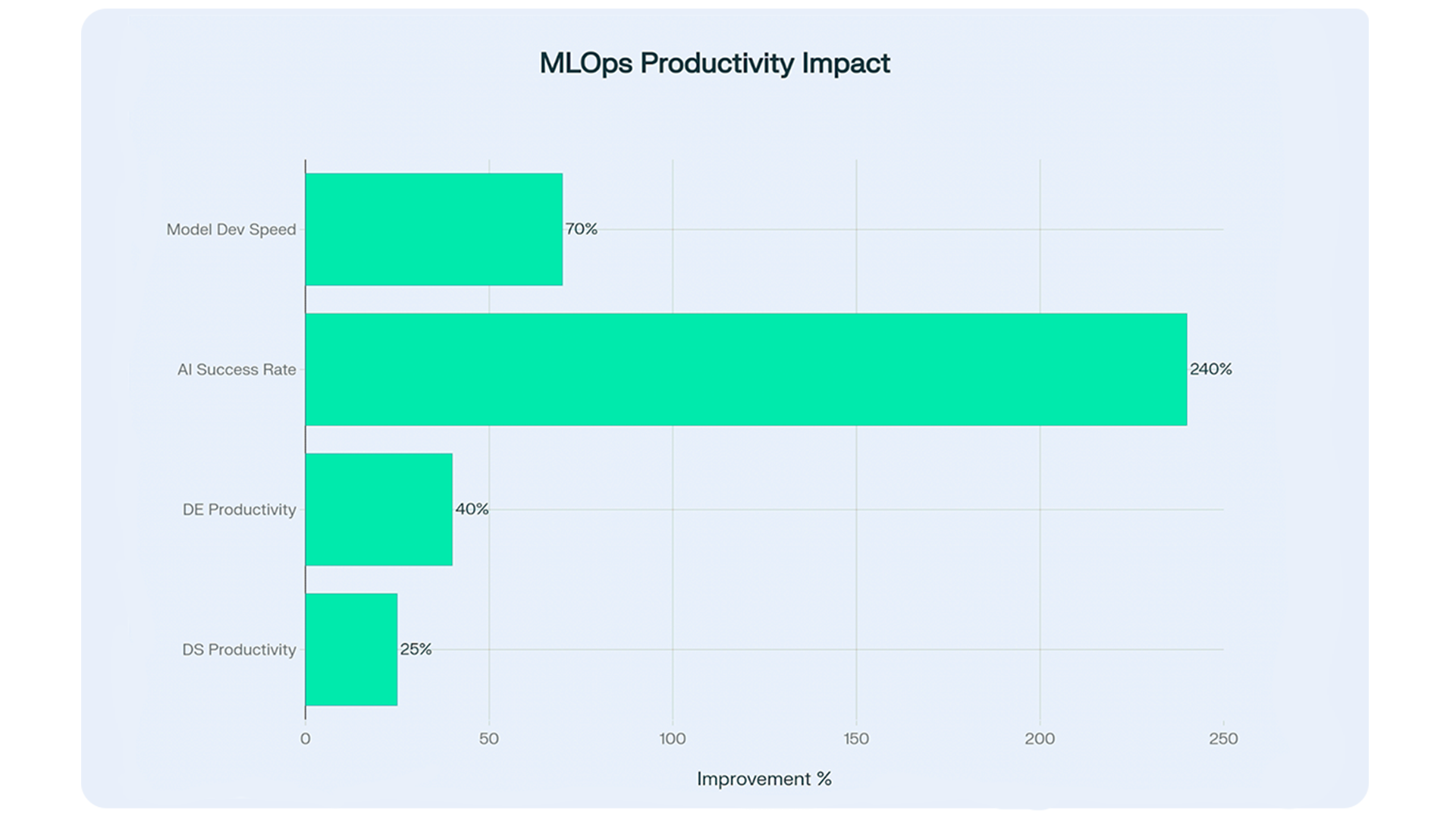
Accenture’s research drives this point home with hard numbers. Companies with AI-led processes don’t just edge out their competitors—they demolish them. We’re talking about 2.4x greater productivity gains and significantly higher success rates when scaling AI applications. The secret sauce isn’t better technology; it’s better operations.
The business case for MLOps: Where strategic vision meets measurable returns
Let’s get down to what actually matters to you: the money. Microsoft’s comprehensive Total Economic Impact study—based on interviews with five enterprise customers and surveys of 199 decision-makers—provides concrete evidence that MLOps isn’t just operational efficiency, it’s competitive warfare.
Organizations implementing Azure Machine Learning with proper MLOps practices reported data scientist productivity improvements of up to 25% and data engineering productivity gains of up to 40%. But here’s where it gets interesting: these weren’t just feel-good metrics. The productivity gains translated directly into $561,000 to $866,000 in cost savings over three years.
The revenue impact tells an even more compelling story. Companies achieved up to $2.5 million in increased revenue and cost savings from better machine learning insights. This wasn’t theoretical value; it came from deploying higher quality and volume of ML models that actually worked in production, maintained accuracy over time, and drove measurable business outcomes.
Probably the most telling statistic comes from cost avoidance. Organizations retired legacy solutions and saved up to $1.7 million over three years by eliminating expensive on-premises licensing, development, administration, and support costs. When you can simultaneously increase revenue, reduce costs, and accelerate time-to-market, that’s not operational improvement—that’s market dominance.
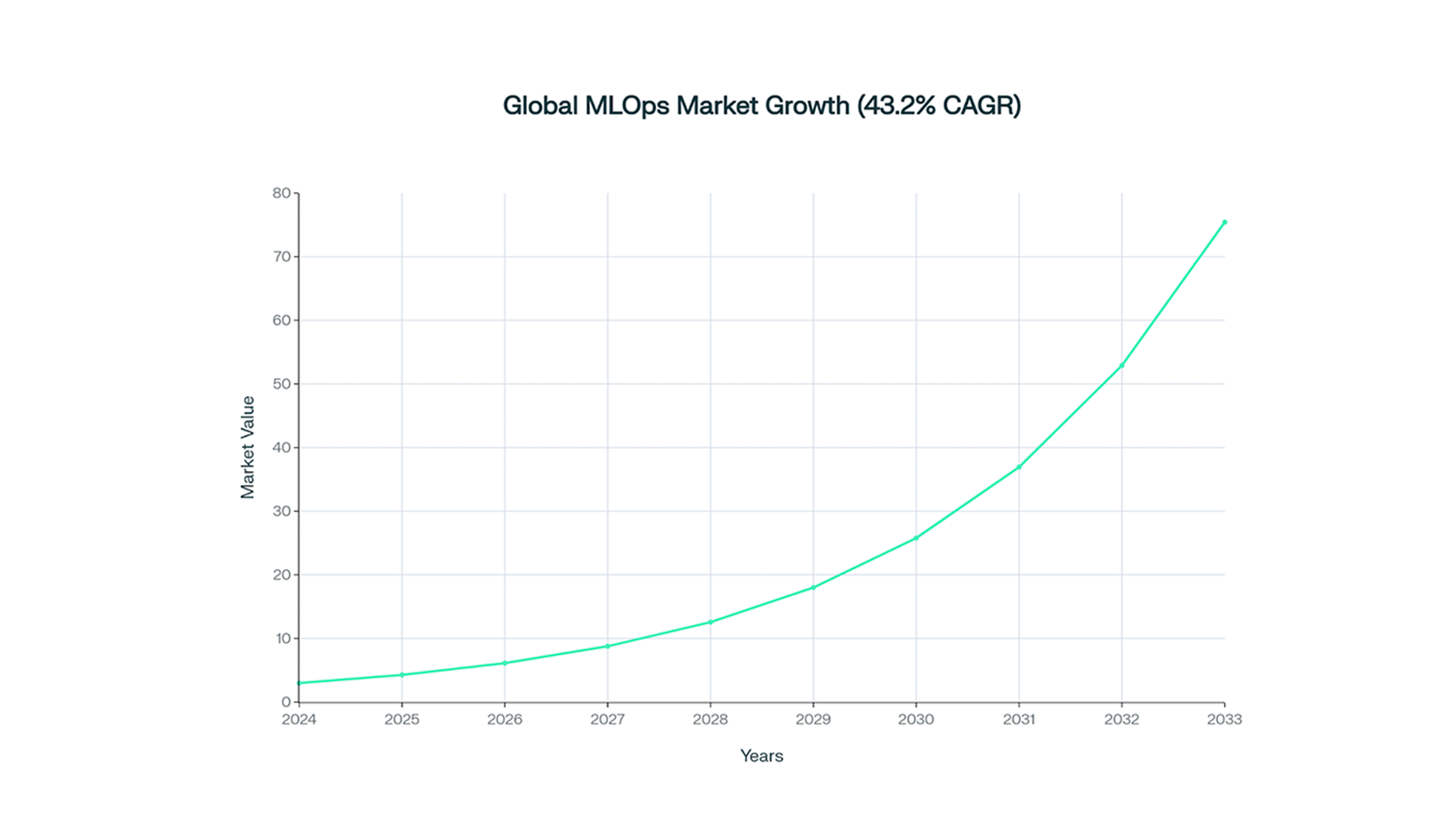
The broader market validates these findings. The global MLOps market is projected to explode from $2.98 billion last year to $75.42 billion by 2033. That’s a CAGR of 43.2%. And this isn’t hype; it’s enterprises voting with their budgets. Because the alternative is competitive irrelevance.
What MLOps means for your organization
MLOps applies proven DevOps principles to the unique challenges of machine learning models. If you’ve benefited from DevOps practices in software development—faster deployments, better reliability, automated testing—MLOps promises similar improvements for AI systems.
The key difference is that machine learning models are fundamentally different from traditional software applications. Your typical web application behaves predictably once deployed. Feed it the same input, get the same output. ML models live in a more complex world where data patterns shift, model performance degrades over time, and silent failures can cost serious money before anyone notices.
MLOps vs traditional IT operations
Traditional IT operations focus on keeping systems running and secure. MLOps adds layers of complexity that would make your infrastructure team’s head spin. Models need retraining when data drifts. Performance monitoring requires statistical analysis, not just uptime checks. Deployment rollbacks become tricky when you’re not sure if poor performance is due to code bugs or changing business conditions.
This complexity is why many organizations struggle with AI deployment. Your existing IT operations team can probably deploy a model to production, but they can’t necessarily tell you when that model stops providing business value or starts making biased decisions that create regulatory risk.
How MLOps drives competitive advantage
Companies with mature MLOps practices can iterate faster, deploy more reliably, and scale AI applications across business units. While competitors debate whether their models are ready for production, these organizations are already capturing value and learning from real-world performance.
The competitive advantage compounds over time. Each successful AI deployment builds organizational capability. Teams learn what works, platforms mature, and business stakeholders develop confidence in AI-driven processes. Meanwhile, organizations stuck in pilot purgatory watch opportunities slip away.
Essential MLOps best practices for growth
1. Executive-aligned strategy and governance
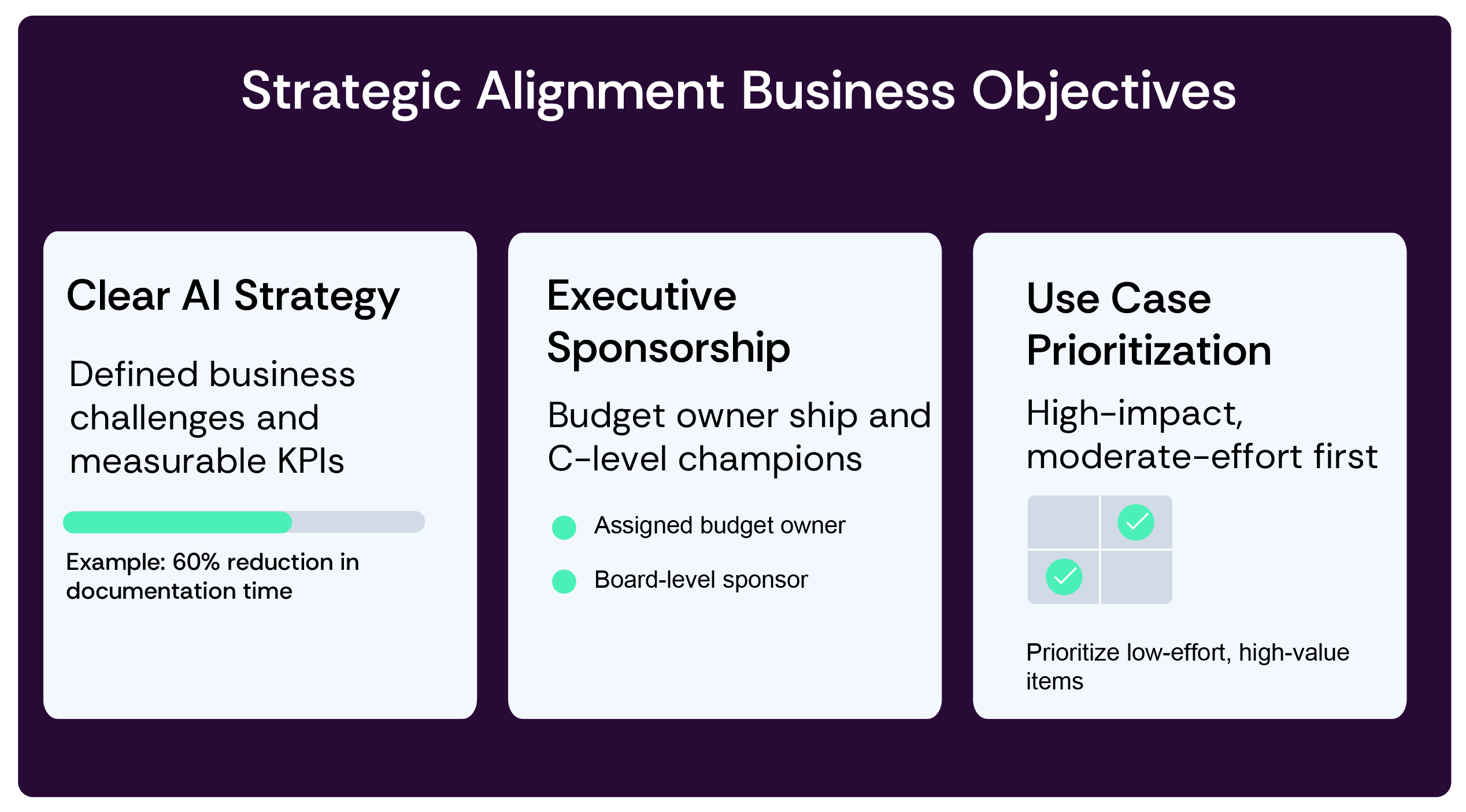
Don’t treat MLOps like it’s just another IT project that happens in the basement. The most successful implementations start with executive sponsorship. This is because MLOps is fundamentally about business transformation, not just model deployment. Microsoft’s research shows that organizations with proper governance frameworks see dramatically higher success rates.
2. Business-driven model development and validation
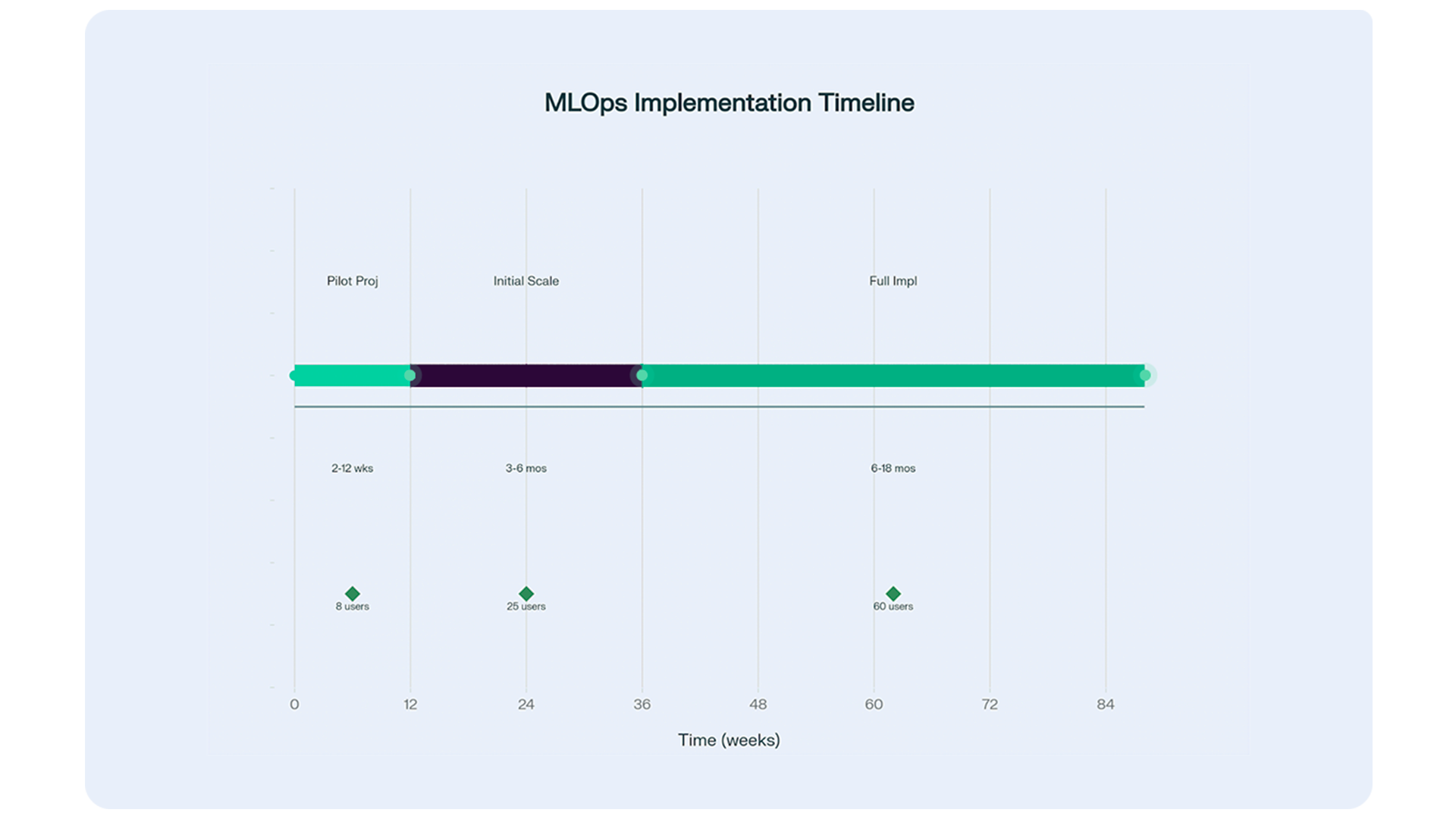
Build models that solve actual business problems. Otherwise, it’s just an impressive academic exercise. Focus on high-value use cases with measurable ROI potential. The composite organization in Microsoft’s study scaled from 8 users in Year 1 to 60 users in Year 3 precisely because early wins justified expanded investment.
3. Automated CI/CD pipelines for competitive responsiveness
Manual deployment can be a headache for both productivity and competitiveness. Teams relying on manual ML workflows face delays and higher error rates, while those embracing automated pipelines can cut model development time dramatically; sometimes from months to weeks, or even less. Instead of wasting talent on repetitive steps, automation frees up experts to focus on high-value problems, making streamlined deployment a real asset in fast-moving markets.
4. Production-ready monitoring and performance optimization
Machine learning models aren’t “deploy and forget” solutions—they require continuous monitoring as data patterns shift. Organizations implementing comprehensive monitoring reported that data scientists saved 5 hours per week each through automated alerting systems. That’s not just efficiency; that’s freeing your most expensive talent for high-value work.
5. Data quality management for reliable decision-making
Poor data quality costs businesses millions in failed projects and unreliable insights. When data teams spend most of their time wrestling with inconsistent formats, missing values, and siloed datasets, they’re not building models that drive business value. Proper MLOps frameworks streamline data sharing and analysis workflows, letting teams focus on solving actual business problems instead of fighting with messy data pipelines.
6. Cross-functional team collaboration
Most organizations struggle with the classic handoff problem: data scientists build brilliant models that engineers can’t deploy, while business stakeholders wait months for solutions that may not even address their real needs. When teams actually work together from day one by sharing tools, processes, and accountability, then everything moves faster. Research shows that organizations with integrated MLOps workflows see significant reductions in both deployment time and effort, simply because everyone’s working toward the same goal instead of throwing work over departmental walls.
7. Scalable infrastructure and resource management
Plan for success by building infrastructure that handles growth profitably. The goal isn’t just getting models into production; it’s scaling them economically. Cloud-based MLOps enables pay-as-you-scale models that eliminate upfront infrastructure investments while providing instant access to high-capacity resources.
8. Continuous improvement and impact measurement
You know what they say: What gets measured gets managed. But what gets measured correctly gets optimized. Implement comprehensive KPI tracking for deployment frequency, mean-time-to-recovery, and revenue impact. Organizations with mature measurement frameworks are significantly more likely to achieve sustained business value.
Advanced MLOps practices for sustained competitive advantage
AI governance and regulatory compliance
As regulatory frameworks like the EU AI Act demand comprehensive audit trails, advanced MLOps becomes competitive differentiation. Organizations implementing proper governance report reduced compliance risk and faster regulatory approval processes.
Multi-cloud and edge deployment strategies
Prevent vendor lock-in while enabling infrastructure flexibility. Microsoft’s customers valued end-to-end platform integration that worked across hybrid environments while maintaining operational consistency.
Predictive model risk management
Advanced organizations implement automated model risk assessment and mitigation. This includes bias detection, performance degradation prediction, and automated remediation workflows that maintain model integrity without human intervention.
Integration with emerging technologies
Future-proof implementations require integration planning for Large Language Models and generative AI capabilities. The most successful organizations build MLOps frameworks that can adapt to emerging technologies while maintaining operational excellence.
Conclusion
MLOps has evolved from optional technical practice to business imperative that determines AI success. Microsoft’s comprehensive research demonstrates that organizations implementing proper MLOps frameworks achieve measurable competitive advantages while those neglecting MLOps face mounting risks from model drift, compliance exposure, and competitive disadvantage.
The question isn’t whether your organization needs mature MLOps capabilities—it’s whether you’ll develop them before competitors capture market advantage. Companies implementing systematic MLOps approaches capture disproportionate value as operational excellence becomes the standard foundation for enterprise AI.
Frequently Asked Questions: MLOps Business Implementation
Q: How long does MLOps implementation typically take?
Microsoft’s research shows that organizations can achieve initial business value within 2-12 weeks for pilot projects, with full-scale implementation requiring 6-18 months depending on organizational maturity and scope.
Q: What’s the minimum investment required for meaningful MLOps results?
The composite organization in Forrester’s study achieved positive ROI with initial teams of 5-8 people, suggesting that meaningful results don’t require massive upfront investment—just systematic approach and proper tooling.
Q: How do we measure MLOps success beyond technical metrics?
Focus on business impact metrics: revenue attribution, cost savings, time-to-market acceleration, and competitive advantage. Microsoft’s customers achieved $1.6M to $2.5M in measurable business value over three years.