About the author

Srđan Peter Jozić
Senior Business Development Manager
According to the Deloitte Global Outsourcing Survey, in 2024, 42% of their respondents pinpointed improved access to talent as a primary driver for adopting dedicated teams. The top five scope areas they outsource the most are IT infrastructure services, cybersecurity, innovative technologies, data and analytics, and application and software development.
Contrary to the survey four years ago, when 70% of organizations outsourced mostly for cost optimization, while in 2024 only 34% cited the same reason. Not only that, organizations are more focused on leveraging outcome-based delivery models.
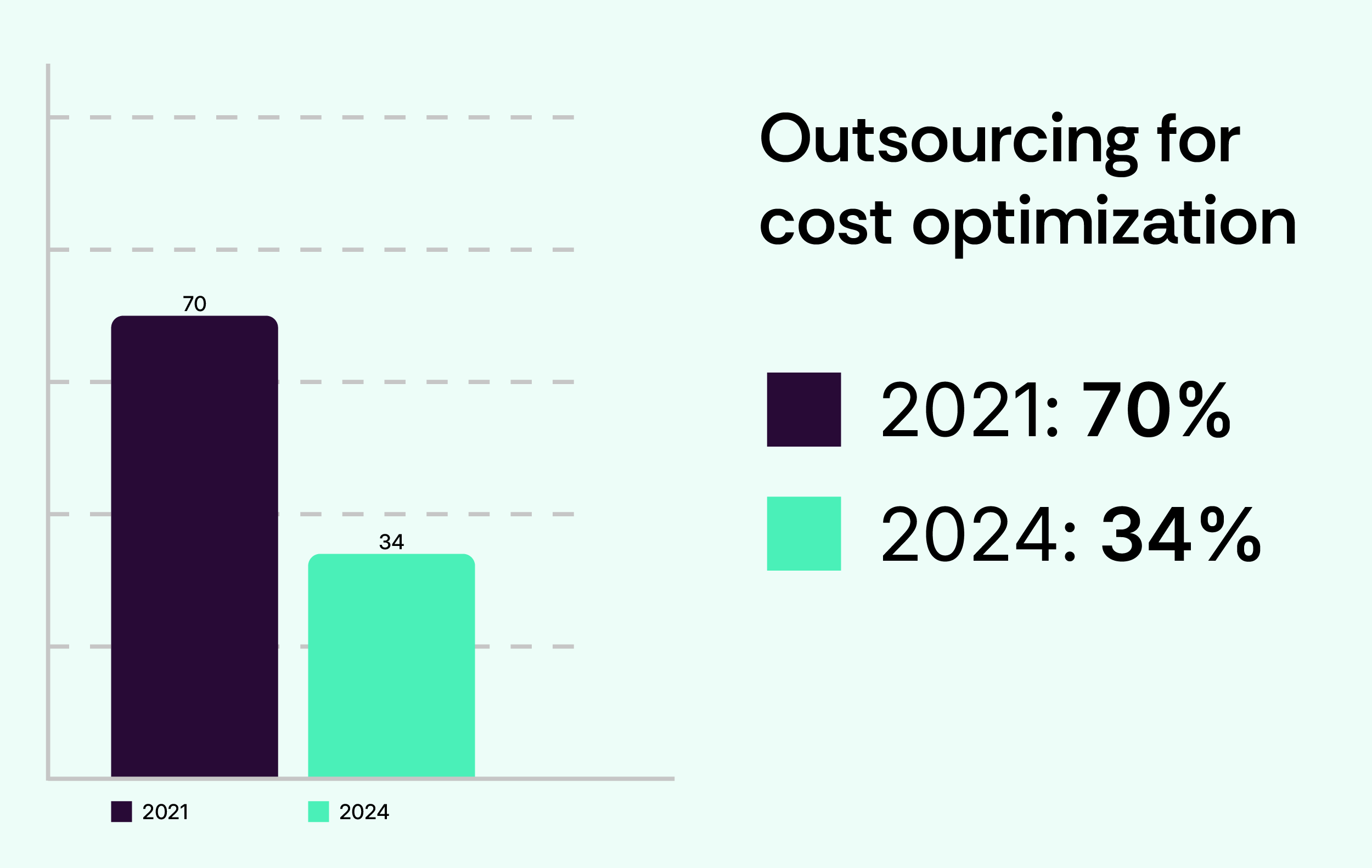
The growing adoption of outcome-based delivery models is redefining the value proposition for outsourced services—from sourcing low-cost talent to sourcing value-added capabilities. Businesses today are prioritizing talent, service quality, global delivery, and agility, in addition to spend optimization to address the evolving business demands.
Types of Outsourcing Models
There are three main models of outsourcing: staff augmentation, project-based model, and dedicated team model.
You’d go for staff augmentation when you need an expert or two (it can be more). But it’s usually short-term. Just filling a skill gap on a project so you don’t have to go through the hiring process just to fill that one project’s need.
In a project-based model, you outsource experts to deliver the whole project from start to finish. They are solely responsible for the outcome. And it’s a great solution when you don’t have a big in-house team or enough people and resources to develop your own solution.
A dedicated team model is a team assembled according to your project needs. The project is still in your hands, and usually, there are a couple of experts on your in-house team, while a dedicated team acts as their extension and integrates into your process. Dedicated teams are great if you’re looking for a long-term solution and staying OpEx-friendly.
In this blog, we want to focus more on dedicated teams since there are multiple possibilities for using a dedicated team and numerous benefits this model brings.
Benefits of using dedicated development team services
1. Cost-effective
It’s simply more cost-effective than employing your team because you don’t have to:
- waste time on lengthy hiring processes,
- worry about how competitive salaries are,
- take care of any overhead costs,
- think about staying OpEx-friendly.
Also, a dedicated team model is great for cost tracking and predicting future costs, as its prices are usually agreed upon with time and material contract. That is generally done for a specific time period, and each role needed on the project.
2. Scalability
The scalability of the dedicated team is closely tied to cost-effectiveness. Maybe you started with ten people, but after a while, you need a few more hands on the deck to achieve your KPIs. Or you need to slow down and scale down quickly because your budget got tighter after Q2. No worries, a good software development partner should take care of both of these scenarios ASAP.
The other thing you don’t have to worry about with a dedicated team is your responsibility to utilize the team or a hired talent after your initial project or the phase of the project they were needed for is done. As you know, that is sometimes difficult or even impossible to achieve.
3. Easy access to talent
You’re limited to your local talent if you work from the office. With a dedicated team, your talent pool suddenly expands to the whole world, or at least expands to nearshore.
The same goes if your industry is not IT-focused. If your industry is construction, healthcare, or banking, there is a possibility experts you need won’t be drawn to it directly.
With a software development partner with experience in your industry, you can easily create a dedicated team structure with experience and expertise in your domain.
It’s also important to mention that many consider dedicated development teams to be only developers and engineers. However, your dedicated team can include different experts who are key to delivering your project successfully and quickly, such as:
- Business Analysts
- Project Managers
- Product Owners
- UX/UI Designer
- QA Testers
4. No hassle with hiring
Hiring is a long process! After the CV submission period, there is a first round of interviews, a test that shows the knowledge and expertise, and another round of interviews to check the cultural fit. And we’re still not done! You make an offer, you go back and forth, and so on and on…
It’s not only time-consuming – many people are involved, and their time could be spent doing something with greater value added. And, of course, there is always a possibility of a person quitting, which means a new hiring process and onboarding and training.
Although that’s a possibility that can also happen in your dedicated team, your software development partner is the one who takes care of everything mentioned above and the following:
- Finding an appropriate substitute
- Onboarding, both to their company and your project
- Continuous development without any disruptions
When to outsource a dedicated team?
As we mentioned, a dedicated team is an extension of your in-house team. They bring additional technical knowledge, expertise, and experience to the table.
Think about outsourcing a dedicated team when:
- You don’t have the necessary talent and time to undergo the hiring process.
- Your company is lacking specific technical knowledge and know-how.
- The project’s scope grew, and you need to scale up quickly.
These are also scenarios where you can rely on a dedicated development team for:
1. Long-term projects
A dedicated software team is best when you need a long-term team solely focused on working on your project or product. A dedicated team will develop a deep knowledge of your product and ensure the stability and consistency of development.
2. Large projects
For example, in enterprise application development, there are multiple components, integrations, and, very often, multiple teams working on different systems at the same time. Usually, dedicated teams focus on one part of the system or join multiple in-house teams when they lack certain skills or expertise.
3. Evolving requirements
Dedicated teams are known for their flexibility and scalability. That means they can quickly adapt to the most demanding challenges and changing circumstances.
4. Continuous support
Most projects are live organisms. Don’t worry, it doesn’t mean that the development will never actually be finished. Some products, like enterprise applications, require maintenance and, now and then, improvements. A dedicated development team ensures that your product is always up-to-date and any bugs are fixed ASAP.
5. Startups or MVPs
Of course, you can’t have a huge in-house team if you’re a startup. But, with a dedicated team, you might as well. They can work closely with you to quickly create a Minimum Viable Product or first iterations of your product. Also, Business Analysts in dedicated teams can help you confirm product-market fit before making huge investments.
How to select a dedicated team?
Working with a dedicated software team is almost always a long-term commitment, so among all software development companies, we know it’s a hard decision to make.
We want to be on the same page with our clients, so at Notch, we usually start with a workshop that involves our business development managers, but it also immediately involves our technical experts and business analysts.
It’s crucial to understand which capabilities you need, as well as your ultimate goal of having a dedicated team.
We also want to find people among our 160 industry experts compatible with your needs. And we’re not talking only about technical, but about cultural fit.
Our goal is always to find people who will seamlessly integrate with your internal processes, culture and your in-house team, allowing quick time-to-value, knowledge transfer, and ongoing innovation.
Each person who’s potentially joining your team, we want to be absolutely sure they are the right fit. So, they go through a round of interviews with you. After all, it is your project, your team, and your roadmap, and we want you to be absolutely in control.
Try dedicated team model
When you rent, you usually don’t have to cover the costs of fixing the roof and replacing the pipes, although both are essential to your daily life.
The same is true with a dedicated team.
Although experts on that team are essential to your project, you don’t have to worry about the hiring process, keeping their compensation competitive, further career development, and overhead costs.
Also, you don’t have to worry if you suddenly need to scale up or down, as your software development partner manages both situations.
A dedicated team means you’ll get experts who will work exclusively on your project, get to know your domain and industry, and bring their own expertise to the table.
If you want to meet experts who can be a part of your next project, contact us.